Showing posts with label Himalayas. Show all posts

Wednesday, September 3, 2014

Aerial Drone Video of the Khumbu Himal (Mt. Everest Region)

This past May (2014), Jon Miller from The Rest of Everest trekked through the Khumbu Himal (Mt. Everest region in Nepal) with two quadcopter drones equipped with video cameras. Upon returning, he edited the footage into a polished, twelve-minute video, which you can watch here:


The video provides stunning birds-eye views of Renjo La, Gokyo, Cho La, and the southside basecamp of Mt. Everest. Everest basecamp is observed to be eerily deserted after the massive avalanche into the Khumbu icefall a month earlier, which claimed sixteen lives.

The video is particularly riveting for me, because I spent 45 days trekking through that region some years ago. It's amazing to be able to relive my experiences of the places listed above, especially the somewhat obscure Renjo La and Cho La passes, through the eyes of the remote-controlled quadcopter. It was also gratifying to have first viewed the video with Jon Miller himself, on a beach in Maine, of all places.    

Thursday, September 27, 2012

"Buried in the Sky" review


Though I'm currently engrossed in producing my first full pop/rock album, I recently took some time to read Buried in the Sky: The Extraordinary Story of the Sherpa Climbers on K2’s Deadliest Day.  The book, published in 2012 and written by Peter Zuckerman and Amanda Padoan, revolves around the series of fatalities that occurred just below the summit of K2 in August 2008.  
I’ve read scores of books over the years that recount mountaineering epics, but this one is different.  Although it does what most readers of the genre will want it to do – it describes the accidents and their surrounding circumstances in the best detail the second-hand authors could muster – it also shines the spotlight on the people who have mostly labored in the shadowy fringes of the genre: the Sherpas. 

The first few chapters of the book trace the trajectories of the Sherpas involved in the disaster.  What these chapters do is firmly establish in the readers mind that the Sherpas are not second-class sidekicks, but fully-fledged actors on par with their (mostly) white counterparts.  And what the book as a whole does is show that, although many of the people involved are competent mountaineers, they are vulnerable human beings who willingly put themselves in harm’s way and suffered the consequences.    

If you are looking for a mountaineering book that portrays glorious heroes, this is probably not for you.  However, if what you are looking for is a very well-written, thoroughly researched and engaging account of a contemporary mountaineering disaster, then I recommend this book. 

Monday, February 13, 2012

"The Last Step: The American Ascent of K2"

The Last Step: The American Ascent of K2 by Rick Ridgeway is a thorough and very well-written account of the 1978 expedition that put four Americans on the summit of the world's second highest peak.  Led by Jim Whittaker, who had been the first American to climb Everest in 1963 (and by a new route at that), the expedition was only the third (1954, 1977) to put climbers on K2's summit. 

The four climbers who summitted were Lou Reichardt and Jim Wickwire on one day and Rick Ridgeway and John Roskelley on the next.  Wickwire endured an open bivouac just below the summit, for which he later paid a steep price, and Ridgeway's and Roskelley's tent and one sleeping bag were destroyed by a stove fire after returning to camp from the summit.  Remarkably, there were no fatalities on the expedition.

The team of fourteen climbers took over two months to forge the route up the Northeast Ridge, which had never been followed to the summit. Like most expeditions on 8,000-meter peaks, this one sounded miserable.  Everyone suffered. Adding to the complexity, but ultimately making for a better read, was the affair between Chris Chandler and Cherie Bech, especially because Cherie's husband Terry was also on the expedition.   

Friday, February 11, 2011

Review of "The Last Man on the Mountain"

In 2002, Jennifer Jordan was wandering around near the base camp of K2 when she stumbled upon the remains of Dudley Wolfe. Wolfe, or what was left of him, had not been seen since 1939 when he was left for dead at nearly 25,000 feet on K2.

Nobody who survived the 1939 American K2 expedition saw Dudley Wolfe die. The three Sherpas who were positioned to rescue him never returned and subsequent attempts did not get close. The controversy surrounding Wolfe’s death persists to this day. Inspired by her discovery of Wolfe’s remains, Jordan published a book in 2010 about the controversy, entitled The Last Man on the Mountain: The Death of an American Adventurer on K2.

Dudley Wolfe was rich. His father had married into one of the wealthiest families in America. Perhaps that is why Wolfe was recruited by Fritz Wiessner, the expedition leader. Unfortunately, the team Wiessner managed to assemble was relatively inexperienced and unprepared for the undertaking.

Some Himalayan expeditions are utterly miserable from start to finish, and this was no exception. Before even setting foot on the mountain, one of the team members nearly died from illness in base camp. And the group dynamics were atrocious, with nearly everyone seemingly despising Wiessner.

Though lacking experience, Wolfe proved to be one of the strongest climbers. Only two other climbers got higher than him, and he probably spent more time than anyone high on the mountain. But this is presumably what did him in.

After Wiessner and Pasang Lama got tantalizingly close to the summit, they were forced to descend. Wiessner and Lama reunited with Wolfe at one of the higher camps, but for reasons that may never be known, left him at the 25,000 foot camp. As Wiessner and Lama descended to resupply at a lower camp, they were mortified to discover that all of the precious camps above base camp had been inexplicably emptied. They were thus forced to descend all the way to base camp. By this point, some of the team members had started home. But poor Dudley Wolfe was stuck at 25,000 feet. The attempt to rescue him resulted in the disappearance of three Sherpas. Wolfe was not seen again for 63 years.

Some books about major expeditions are exceptionally well-written and even funny. This one is neither. But the writing is clear and the research thorough, with the possible exception of one factual error. Contrary to Jordan, I thought that Wiessner first saw the Gunks not from the Shawangunk Mountains (the Gunks are in the Shawangunk Mountains), but from Breakneck Ridge in the Hudson Highlands. But that is an exceedingly minor point.

Breakneck Ridge. A fun scramble on the Hudson.
 
This book will lack appeal for those seeking a heroic, romanticized, and inspiring account of a Himalayan expedition. But for those with a deeper interest in the genre, Jordan’s book is an engaging and realistic analysis of a low point in American mountaineering.

Friday, January 29, 2010

Review of "Annapurna South Face"

Thirty-nine years after its publication, I finally got around to reading Annapurna South Face by Sir Chris Bonington. The book is an account of the expedition Bonington led on the South Face of Annapurna in 1970.

At 8091 meters, the summit of Annapurna is the tenth highest in the world. Though Annapurna was the first 8000-meter peak to be climbed (by a French expedition in 1950), it is often considered to be the hardest. According to various websites, Annapurna is the least frequently climbed 8000-meter peak, but has the highest fatality rate: for every two climbers who have summitted, roughly one has died trying. It was also the last of the fourteen 8000-meter peaks that Ed Viesturs climbed, and it took him three expeditions before he reached its top.

On May 27, 1970, two members of Bonington's expedition – namely, Dougal Haston and Don Whillans – made it to the summit after roughly two months of hiking and climbing. They missed getting the second ascent of Annapurna by a matter of days. Their achievement was supported by the incredibly hard labor and commitment of dozens of other climbers and Sherpas. One merit of Bonington's book is its emphasis on the tremendous sacrifices others made to position Haston and Whillans for their summit bid.

It seems to me that major mountaineering expeditions are like human pyramids, in that the person on top is not necessarily the hardest working or most competent member. In the case of a human pyramid, the person on top deserves no more credit than anyone else. But for some reason, in mountaineering expeditions the persons who summit tend to get more credit and reap more rewards than anyone else. Think of Sir Edmund Hillary and Tenzing Norgay. Few people could name any other members of their expedition. Off the top of my head, I can only think of one – the leader of the expedition. One could argue that on many major mountaineering expeditions the supporting climbers deserve most of the credit, because the climbers who summit are already rewarded by getting to stand on the summit.

In addition to giving credit where credit is due, Bonington provides an unmistakable sense of the difficulty and complexity of a major mountaineering expedition. The book is actually a bit tedious in this regard, but after 100 pages of details about ferrying loads between high camps, one is unlikely to forget that element. One surprising and disappointing feature of the book, especially in light of how much attention is given to load-ferrying, is how little is devoted to the successful summit day. Seemingly out of the blue, after almost three hundred pages, Bonington announces that Haston and Whillans reached the summit and then defers to Haston's hurried account of what transpired from May 17-27. Bonington then concludes with a few pages about the descent to base camp, which included the death of the accomplished climber Ian Clough in an avalanche. Though Bonington devotes an almost negligible amount of text to summit day, he certainly cannot be faulted for giving excessive credit to the climbers who managed to summit.
 
 
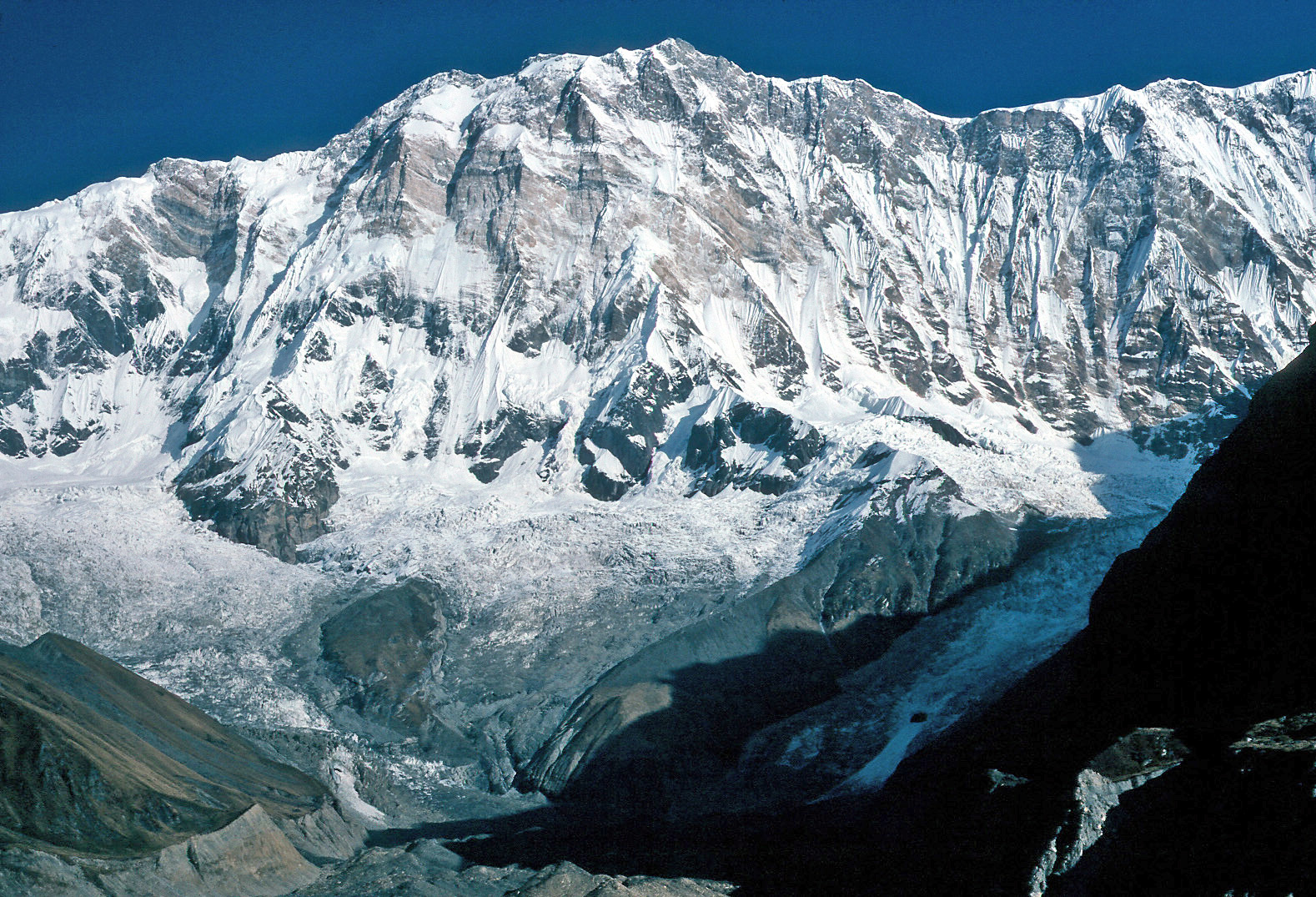
The South Face of Annapurna (photo by Wolfgang Beyer, Wikipedia)
 
Ian Clough's death on Annapurna was not the only fatality on one of Bonington's expeditions. From 1975-1982, four more of Bonington's British teammates died on Himalayan expeditions he led – namely, Mick Burke, Nick Estcourt, Peter Boardman, and Joe Tasker. Clint Willis does an excellent job of chronicling these expeditions and their consequences in The Boys of Everest: Chris Bonington and the Tragedy of Climbing's Greatest Generation (2007, 560 pages). Reading that book made me wonder about the propriety of leading expeditions that repeatedly kill people, but I've reached no conclusions.

Considering that Bonington was 35 years old when he led the Annapurna expedition in 1970, it is amazing how active he still is at 75. This past September he climbed Mont Blanc. This May he will be participating in a 22-day trek in the Annapurna region of Nepal. The trek will serve as a 50-year anniversary of his first ascent of Annapurna II (7937 meters) in 1960. Think about that. Bonington climbed a major peak in the Himalayas fifty years ago and will be trekking back to it this year. If you cannot keep up with Sir Chris Bonington in the mountains, you can at least keep up with his personal website or Berghaus blog.

Sunday, January 24, 2010

Two New Routes on Tawoche (with Remarks on Fowler-Littlejohn)

In the last two months, two new routes have been climbed on Tawoche (~6500m), a spectacular peak near Mt. Everest.


Tawoche on the left (photo by Uwe Gille, Wikipedia)

In late November, Fumitaka Ichimura and Genki Narumi climbed the Direct North Face, which involved 1500 meters of steep and dangerous ice/snow. The climb took four days round trip from a base camp at roughly 5000 meters. They spent two nights on the face sitting on ledges with no tent. For more details, see Alpinist and Climbing.

Just a few days ago, Renan Ozturk and Corey Richards climbed Tawoche's South Central Buttress. From a base camp at around 5000 meters, two days of rock climbing and a third day of ice climbing brought them to the summit. They then rappelled their route of ascent. Though they were able to set up a tent at their two camp sites on the wall, there was no water or snow at their first site, so they went 36 hours without water. Sophisticated video dispatches are posted on Ozturk's blog, which are well-worth watching.

Reading about these recent climbs reminded me of the first ascent of the Northeast Buttress on Tawoche by Mick Fowler and Pat Littlejohn in 1995. Though Fowler's American Alpine Journal article, entitled Tawoche: A Retrospectively Pleasurable Ascent, is well-written and even hilarious, it has one glaring omission: it neglects to mention the extremely minor contribution I made to the expedition.

For 45 days in the spring of 1995, I was trekking in the Khumbu Himal. Near the end of my trip, I was lounging around the Peace Zone tea shop in Pheriche when four British guys approached on the trail. They looked like novice trekkers who were out of their element. After they settled in at the tea shop, I inquired about their plans, assuming that what I had already done would be more impressive than what they were going to do. Mick Fowler, who was one of the novice trekkers, said, "Well, do you want to have a look?" That was the first indication that something was awry. From the path outside of the Peace Zone, I was astonished to watch as he pointed out a route up the jaw-dropping Northeast Buttress of Tawoche. Speechless, it was clear that I was the novice and they were the pros. As if to emphasize the point, Chris Watts handed me a picture of Tawoche torn from a magazine. Absentmindedly turning the page over, I was amazed to see a full-page advertisement featuring him rock climbing.

Having been put in my place, I hung around the Peace Zone for a few more days while Fowler, Watts, Pat Littlejohn, and Mike Morrison acclimated and waited for porters to arrive with gear. Eager to establish base camp below the buttress, they huddled to figure out how to deal with the lagging porters. Overhearing their discussion, I offered a solution which was promptly dismissed. A day or two later I asked how the logistical problem was solved and was surprised to hear that my solution had been adopted.

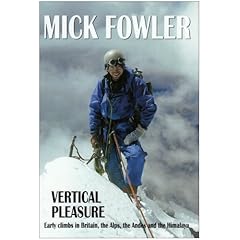
Mick Fowler was awarded the Piolet d'Or in 2003. He has also written two excellent books: Vertical Pleasure: The Secret Life of a Tax Man (1995) and On Thin Ice: Alpine Climbs in the Americas, Asia and the Himalaya (2005). Had I not met Fowler below Tawoche, I probably would not have read his books, which in my opinion are among the best in the mountaineering genre. For a sample of his writing, see the AAJ link above or Fowler's occasionally updated blog.

Friday, December 11, 2009

What Really Happened to Mallory and Irvine

Today is International Mountain Day.  There could hardly be a better time to reflect on why you climb mountains.  And when contemplating the question "Why do you climb?", you may find yourself distracted by the infamous answer attributed to George Mallory: "Because it is there."  But what exactly did Mallory mean by this cryptic quip?  Theories about his meaning are as various as theories explaining his disappearance high on Mt. Everest in 1924.

The Wildest Dream, a movie scheduled for release in 2010, promises to shed light on the enduring conundrum of Mallory and Irvine's disappearance.  However, given that the mountain featured prominently on the movie's website is not Mt. Everest, but a reversed image of Mont Blanc du Tacul in France, I wouldn't hold your breath. [Editor's note: the image was eventually switched to Mt. Everest, perhaps as a result of this article!]  In fact, you may want to take this opportunity to draw a few deep breaths, because there is a brand new theory that simultaneously deciphers Mallory's cryptic quip and explains his disappearance.  And it is a theory that The Mountaineering Review is now proud to unveil on this International Mountain Day eighty five years after Mallory and Irvine vanished.

Solving complex problems often involves challenging assumptions that have been left unchallenged.  Consider again Mallory's retort, "Because it is there".  For too long, scholars and laypersons alike have assumed that by "it" Mallory was referring to Mt. Everest.  But on this day -- a day designated by the United Nations General Assembly as "an opportunity to create awareness about the importance of mountains to life" -- it is the distinct pleasure of The Mountaineering Review to lay bare what Mallory was referring to with the word "it".  When Mallory said that he wanted to climb Mt. Everest because it is there, he did not mean that he wanted to climb Mt. Everest because Mt. Everest is there.  Rather, George Herbert Leigh Mallory wanted to climb Mt. Everest because it is there.  Yes, that's right.  Call it what you like: Yeti, Abominable Snowman, or my personal favorite, Kangchenjunga Rachyyas.   

To reiterate what has been suggested thus far, Mallory wanted to climb Mt. Everest because he believed (or knew?) the Yeti was there.  But what light does that shed on his disappearance, you ask?  Well, if you don't want to get snow blindness, you had better put on your mountaineering goggles.  But first, a refresher on the nature and history of science is in order.  Scientific theories endeavor to explain phenomena -- that is, they try to determine what causes what.  Sometimes, when a scientist finally stumbles on the correct theory, its accuracy seems so obvious in retrospect as to render all rival theories laughably preposterous.  (Incidentally, I know all of this stuff about science because my daughter's brother's grandmother's husband's daughter is a scientist.) 

With a clearer understanding of the nature and history of science, we are now positioned to account for the heretofore mysterious disappearance of Mallory and Irvine.  As with many good scientific theories, as soon as you hear this one, it will seem so obviously correct that all other competing theories (such as the one that will no doubt be presented in The Wildest Dream) will seem, well, wild.  Ok, here it is.  You may want to take a few deep breaths.  George Herbert Leigh Mallory (1886-1924) and Andrew "Sandy" Comyn Irvine (1902-1924) were killed high on the northeast ridge of Mt. Everest (also known as "Sagarmatha" by the Nepalese and "Chomolungma" by the Chinese) by something that I will discuss in a forthcoming blog entry.  I actually lost track of time and ought to be getting ready for bed.  Oh, what the hell, let's do this now: They were killed by a yeti!  That's it, you read that right.  Mallory and Irvine were killed by a yeti.  Have a look at this picture.

Having clearly articulated this intoxicating new theory about what really happened to Mallory and Irvine, a sober evaluation is required.  The history of science demonstrates that the best theories have sweeping explanatory efficacy -- that is, they not only explain the main thing you want to explain, but every other related significant detail as well.  The Yeti theory can obviously explain how Mallory and Irvine died (a yeti killed them).  But can it explain why Mallory's body was found, while Irvine's body was not found?  Yes.  The Yeti ate Irvine (because he was much younger than Mallory), but was too full to eat Mallory.  And now for the explanatory hurdle -- that one little fact that the rival theories just cannot explain.  Why was Mallory's body found with all of his personal effects intact, with one glaring exception: the photograph of his wife that Mallory planned to leave on the summit?  Quite simply, the Yeti stole it.  That is what you call explanatory efficacy.

So, there you have it.  Mallory wanted to climb Mt. Everest because it -- namely, the Yeti -- is there, and Mallory and Irvine were subsequently killed by that selfsame Yeti.  It should go without saying that the timing of the publication of this Yeti "theory" (one is now tempted to say Yeti "fact") could not be any worse for the producers of The Wildest Dream.  Although I'm sure the scenery will be pretty, in light of the Yeti theory, watching the movie will be like watching two teams who failed to make the playoffs in their final regular season game: ultimately, it just won't matter.

Curiously, though not surprisingly, representatives of The Wildest Dream could not be reached for comment.*

* I didn't try to reach them.   

Tuesday, December 8, 2009

Carlos Soria is my new mountaineering role model

Since turning 50, the Spaniard Carlos Soria has summitted nine 8,000 meter peaks.  More impressively, he climbed five of them, including K2, after turning 65, and one of them (Gasherbrum I) at age 70.  He plans to climb all fourteen 8,000 meter peaks by age 75.  But Soria is not just obsessed with peaks rising above the arbitrary 8,000 meter threshold.  Earlier this year, he made the first ascent of Dome Kang (~7,200 meters) in the Kangchenjunga Massif.  Soria worked as a carpenter until "retiring" at 65. 

Part 1 and part 2 of the ExplorersWeb interviews

Thursday, December 3, 2009

Review of "Dark Summit"

In spring 1996, over ten climbers died in a storm while climbing Mt. Everest, including the accomplished leaders of two commercial expeditions, Rob Hall and Scott Fischer. The story of that terrible season was told, not without controversy, by Jon Krakauer in his best-selling book Into Thin Air. In spring 2006, over ten climbers again died climbing Mt. Everest, but this time in relatively fine weather. Nick Heil explains what went wrong in his book Dark Summit: The True Story of Mt. Everest's Most Controversial Season, published in 2008.

Though most of the action in 1996 took place on the south side of Mt. Everest, it was the north side that stole the show in 2006. There are two main reasons why climbing from the north side became more popular. First, the standard route on the south side passes through the extremely dangerous Khumbu Icefall, which is located immediately above base camp. In order to establish higher camps and acclimatize, climbers are required to play Russian roulette with the precariously balanced ice blocks in the aptly named Icefall many times over the course of an expedition. Dozens of climbers have died in the Icefall. However, there is nothing akin to the Khumbu Icefall on the north side. Second, the permit fees on the northern Chinese side are significantly lower than those on the southern Nepalese side.

After 1996, new commercial operators took root on the north side of Mt. Everest, most notably Himalayan Experience (a.k.a. Himex), run by Russell Brice. Dark Summit is in part a biography of this major player on the world's highest mountain. The achievement that catapulted Brice into the ranks of elite climbers was the first traverse, along with Harry Taylor, of the notorious pinnacles on the northeast ridge of Mt. Everest. Though they were unable to follow the relatively easy ground above the pinnacles all the way to the summit, they had negotiated terrain that killed two of the world's foremost alpinists, Peter Boardman and Joe Tasker. Now, almost two decades after his groundbreaking traverse of the pinnacles, Brice was making a living guiding clients up the easier section of the northeast ridge above the pinnacles.

The world was horrified to learn that on May 15, 2006, roughly forty climbers walked by David Sharp on their way to the summit as he lay dying in the snow. Hearing that Brice had told his guides and clients to let Sharp die, much of the world was outraged. But of course, the story is much more complicated than that, and it is a merit of Heil's book that he carefully and thoroughly describes that complexity. Once that complexity is understood, one gets the sense that fingers were pointed at Brice not because he was guilty, but because aside from Mt. Everest, he was simply the biggest thing around.

For anyone interested in Mt. Everest, especially the recent commercialization thereof, this is a must read. The descriptions and analyses of the various fatalities in 2006 are illuminating, and the biographical sketch of Brice is, for me, the most engaging part of the book. The book is well-written and the opining is kept at reasonable level. The author's professionalism is evident throughout the book, as is his passion for the topic.

Addendum: Interestingly, the following note now appears on the Himex website: "As we are unable to get guaranteed access to Tibet, Himalayan Experience is currently not operating expeditions to Everest North Side. Our alternative is Everest South Side."

Another outstanding book in this genre is High Crimes: The Fate of Everest in an Age of Greed, written by Michael Kodas and published in 2008. Though it has been a year since I read this book, what I remember most is the sustained and shocking harangue against George Dijmarescu (9-time Everest summitter) and the guiding company that his Sherpa wife nominally leads.

Friday, November 20, 2009

Review of "K2: Life and Death on the World's Most Dangerous Mountain"

This book is the second collaborative work by Ed Viesturs and David Roberts.  Viesturs was the first American to summit all fourteen 8,000 meter peaks (and he did them all without supplemental oxygen) and Roberts is a prolific author of mountaineering literature, in addition to being the author of several harrowing first ascents in Alaska.  The book was prompted, or at least made more relevant, by the disaster high on K2 in 2008, in which eleven climbers were killed after the partial collapse of the notorious serac above the crux "bottleneck" section.  The dangerous traverse below this serac is featured on the front cover of the book.  When this incident was first reported, I remember thinking that someone would write a book about it.  This is that book.  Well, sort of.

K2 (the book) switches back and forth between first-hand account/analysis of climbing "the savage mountain" and scholarly history of the many disasters that have unfolded on its flanks in the last century.  The rigorous historical narrative ends, seemingly prematurely, at 1986.  Even though Viesturs is listed as the primary author (the book is by Ed Viesturs with David Roberts), it seems obvious which author wrote which section.  Having read several of Roberts' books, I recognized his characteristic style throughout: lots of quotations (especially from personal journals), dense and careful prose, and the occasional sesquipedalian.  Roberts' style is epitomized in his eye-opening, myth-busting True Summit: What Really Happened on the Legendary Ascent of Annapurna.  Almost by default, I assumed that the sections in the book that were more casual and conversational were penned by Viesturs.

Given Roberts' strong presence in the book, I kept forgetting that Viesturs was the primary author.  Thus, when the writing was in the first person, I imagined Roberts' doing the talking -- that is, until the person talking would mention climbing K2 or some other Himalayan peak, and then I would realize that Viesturs was the one talking.  Another problem with the book is that I experienced deja vu several times, most notably in the chapters on the 1939 and 1954 expeditions.  The writing about the respective American and Italian expeditions sounded too familiar.  I couldn't help but think that I had read something very similar in one of Roberts' other books.  He does seem to have a habit of repeating himself from one book to the next.

Despite the aforementioned problems, K2 is a captivating and enlightening read.  Viestur's unparalleled analyis of the perils of high altitude climbing is educational.  For instance, throughout the book Viestur's extols the virtues of "wanding" routes -- that is, placing lightweight, bamboo gardening wands at regular intervals through sections where routefinding could be difficult in a whiteout -- and provides several studies of cases in which climbers could probably have avoided fatalities had they bothered to wand the route.  Having read this book, I will be much more inclined to visit a lawn & garden center before venturing onto a big, glaciated mountain.